
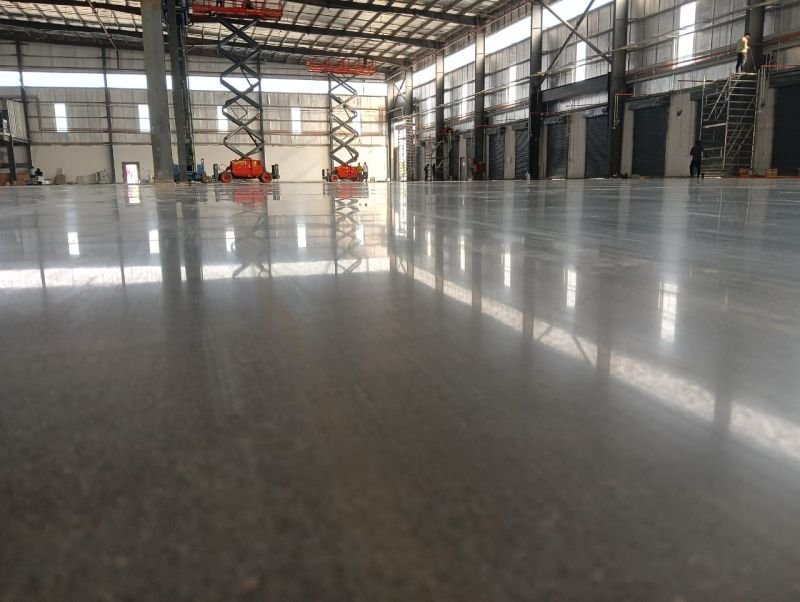
Concrete Floor Polishing
A densifier hardens the slab so it stops dusting; diamond polishing takes it further to a hard, reflective, easy-clean finish.
Concrete floor polishing grinds a slab with progressively finer diamond tools, densifies it part-way through and refines it until it reaches the agreed sheen. The finish is the concrete itself rather than a coating laid over it, so there is nothing on top to peel, blister or wear through. It works on new slabs and on worn existing floors, and it leaves a surface that is hard, dust-free and quick to clean.
- Best for
- New or existing floors that dust, look worn or need to be easier to clean
- Typical sites
- Warehouses, factories, showrooms, workshops, commercial interiors
- Often combined with
- Densification Dust Proofing, Vacuum Dewatering Flooring, Epoxy Flooring
What is concrete floor polishing?
Polishing is a sequence, not a single operation. Metal-bond diamond tooling first takes off laitance, old coatings and surface irregularities and exposes a sound, flat plane of concrete. The slab is then densified, and resin-bond diamonds refine it through finer and finer grits until the agreed sheen is reached.
The densifying step in the middle is what makes the result last. A silicate densifier reacts with free lime inside the cement paste and fills the pores with hard, insoluble material, so the surface being polished is harder than the concrete was to begin with. That same step, used on its own without the fine grinding, is densification dust proofing — the lower-cost option for floors where appearance does not matter.
What the finished floor looks like depends on how deeply it is ground. A light cut leaves mostly cement paste with only a scatter of fine aggregate; cutting deeper exposes more and larger aggregate. That choice is made on a trial area, on your slab, because every pour is different.
Dust proofing or polishing — which does your floor need?
The two share the same chemistry but differ in how much the surface is worked. The right choice depends on how the floor is used and whether its appearance matters.
| Aspect | Dustproofing treatment | Concrete floor polishing |
|---|---|---|
| Main purpose | Stop dusting and harden the surface | A hard, dust-free surface with a refined, reflective finish |
| Surface work | Cleaning or light grinding to open the pores | Progressive diamond grinding from coarse to fine grits |
| Appearance | Largely unchanged, often slightly darker | Matte, satin or high gloss, as agreed |
| Time on site | Shorter | Longer — several grinding and polishing passes |
| Best suited to | Warehouses and stores where function comes first | Showrooms, factories, offices and visible floors |
| Upkeep | Routine sweeping and scrubbing | Routine cleaning, with periodic burnishing to hold the sheen |
Benefits of Concrete Floor Polishing
- Dust controlled at source The surface is hardened, not just sealed, so it stops producing dust instead of hiding it for a few months.
- Better abrasion resistance Densified concrete stands up better to wheels, pallets and foot traffic.
- No coating to fail Polished concrete has no film on top, so there is nothing to chip, peel or delaminate.
- Brighter interiors A polished floor reflects light, which can noticeably brighten large spaces.
- Easier cleaning A tight, closed surface is quicker to sweep and scrub and resists staining better than raw concrete.
- Restores old floors Worn, dusting slabs can often be brought back into service without being broken out.
Where it is used
- Warehouses and godowns
- Manufacturing and assembly floors
- Showrooms and retail spaces
- Workshops and service areas
- Offices and commercial interiors
- Existing floors that dust or look worn
Our Concrete Floor Polishing process
-
01
Floor assessment
The slab is checked for soundness, cracks, old coatings, oil contamination and hardness. This decides the tooling, and whether polishing is realistic or dustproofing is the better choice.
-
02
Repairs
Cracks, damaged joints and spalled areas are repaired first — polishing reveals defects rather than hiding them.
-
03
Grinding
Metal-bond diamond tooling removes laitance, coatings and surface irregularities. For dustproofing alone, grinding is limited to opening the surface.
-
04
Densifying
The densifier is applied and given time to react with the concrete.
-
05
Honing and polishing
For a polished finish, resin-bond diamonds refine the surface through finer grits until the agreed sheen is reached.
-
06
Sealing and handover
A protective sealer is applied, the floor is cleaned, and it is handed over with maintenance guidance.
Quality and safety considerations
- Polishing shows what is in the slab — aggregate, old repairs, stains. Where appearance matters, a trial area is recommended before the full floor.
- Oil- or chemical-soaked concrete needs extra preparation, and badly contaminated areas may not densify evenly.
- Grinding is done wet or with industrial dust extraction to control respirable silica dust.
- Treated areas are cordoned off and signed while work and drying are in progress.
- Joints and cracks are dealt with before polishing so their edges do not chip under traffic.
Why work with us on this
- We will tell you honestly when dustproofing is enough and full polishing is not needed.
- Repairs, joint work and finishing are handled by one team.
- Work can be planned in phases so parts of the facility stay in use.
From our sites
Frequently asked questions
What is dustproof concrete flooring?
It is a concrete floor whose surface has been treated with a chemical densifier so that it no longer sheds dust. Polishing includes that step; where only the dusting needs solving and the finish does not matter, the densifier is applied on its own.
Densification dust proofing
What is the difference between dustproofing and concrete polishing?
Dustproofing hardens the surface with little change to how it looks. Polishing includes the same densifying step but adds progressive diamond grinding, producing a smoother, reflective finish. Dustproofing is chosen for function; polishing when the appearance of the floor matters too.
Can an old, dusty concrete floor be polished?
Usually, provided the slab is structurally sound. Cracks and damaged joints are repaired first. Floors that are badly broken up, very soft or heavily contaminated may need repair or a different solution, which the site assessment will show.
How long does a polished concrete floor last?
The polished surface is part of the slab, so it does not wear off the way a coating does. Its sheen dulls gradually with traffic and can be restored by periodic burnishing or light re-polishing; how often depends on the traffic and cleaning routine.
Is polished concrete slippery?
A clean, dry polished floor is generally not slippery in normal use. Like most hard floors, it becomes more slippery when wet or contaminated with oil or dust, so the finish level and cleaning routine are chosen with the area's use in mind.
How much does concrete floor polishing cost?
It depends on the floor area, the condition and hardness of the existing slab, the repairs needed, the finish level required and site access. Dustproofing on its own costs less than full polishing. We quote after inspecting the floor.
Planning a Floor Polishing project?
Tell us about the site, the finish you need and your programme. We will visit, assess and quote.