
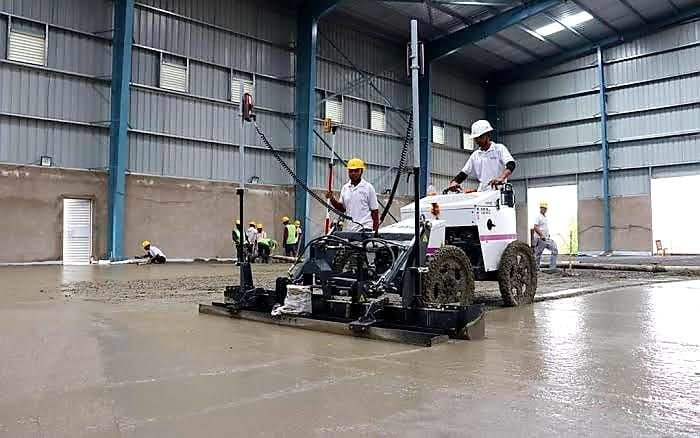
Truss Screed Concrete Flooring
Vibrating truss screeds strike off and compact wide concrete pours in one controlled pass, holding accurate levels over long spans.
A truss screed levels and compacts a wide concrete pour in a single controlled pass. We use vibrating truss screeds to lay large industrial and commercial floors to consistent levels, usually followed by vacuum dewatering and power trowelling.
- Best for
- Wide, long pours that need consistent levels over distance
- Typical sites
- Warehouse and factory floors, sheds, yards and roads, podium slabs
- Often combined with
- Vacuum Dewatering Flooring, Concrete Floor & Slab Cutting, Concrete Floor Polishing
What is a truss screed?
A truss screed is a light, rigid triangular frame — the truss — fitted with a vibrating unit and long enough to span the full width of a pour. It rides on side forms or rails set to the finished level, and is drawn along the strip as concrete is placed ahead of it.
As it travels, the screed does two jobs at once. Its leading edge strikes the concrete off to level, and its vibration compacts the concrete beneath, driving out entrapped air. Because one rigid frame spans the whole width, levels do not drift the way they can with repeated short passes of a hand-held straight edge.
Truss screeds suit long-strip construction, in which a large floor is cast as a series of parallel bays. Each bay is screeded, then dewatered, floated and trowelled, and the next bay is cast against it.
Truss screed, laser screed or manual screeding?
All three strike concrete off to level. They differ in how the level is controlled — and so in the flatness they can deliver and the jobs they suit.
| Aspect | Manual screeding | Truss screed | Laser screed |
|---|---|---|---|
| Level controlled by | Hand straight edge and levels | Side forms or rails | Laser reference with automatic adjustment |
| Compaction | Separate vibrators | Built-in vibration across the width | Built-in vibration |
| Pour layout | Small areas | Long strips between forms | Large open areas with fewer forms |
| Typical use | Small slabs, repairs, tight spaces | Warehouse and factory floors, yards, roads | Very large floors with tight flatness specifications |
| Equipment on site | Minimal | Moderate | Large self-propelled machine |
Benefits of Truss Screed
- Consistent levels One rigid frame across the full width holds the surface on level from form to form.
- Even compaction Vibration across the whole width consolidates the concrete evenly through its depth.
- Faster placing Striking off and compacting in one pass covers large areas quickly, with a smaller crew.
- Fewer hidden defects Even compaction reduces honeycombing and weak zones below the surface.
- Made for long strips Suits casting large floors in parallel bays with planned joints.
- Cost-effective Good levels on big floors without the cost of large self-propelled plant.
Where it is used
- Warehouse and logistics floors
- Factory and production sheds
- Industrial yards and hardstandings
- Internal roads and approaches
- Parking areas
- Podium and basement slabs
Our Truss Screed process
-
01
Set-out
Floor levels and bay layout are set out; forms or rails are fixed and checked along their full length.
-
02
Base and reinforcement check
Sub-base, membrane, reinforcement or fibre dosage and dowel positions are confirmed.
-
03
Placing
Concrete is discharged and spread slightly above finished level so the screed has material to strike off.
-
04
Screeding
The vibrating truss is drawn along the forms, striking off and compacting in one pass; low spots are topped up and re-screeded while the concrete is workable.
-
05
Finishing
The bay is vacuum dewatered where specified, then floated and trowelled.
-
06
Joints and curing
Joints are sawn at the right time and the floor is cured.
Quality and safety considerations
- Forms and rails are the reference for level. They are checked before every pour, because the screed can only be as accurate as they are.
- Workability has to suit screeding — mixes that are too stiff or too wet both spoil the surface.
- Vibration and travel speed are matched so the concrete is compacted without being over-vibrated.
- Screeding is sequenced with the concrete supply so bays are never left half-finished.
- Power cables, vibrating equipment and manual handling of forms are managed as site safety risks.
Why work with us on this
- Screeding, dewatering and finishing by one team, in one planned sequence.
- Bay layout and joint positions planned before the first truck arrives.
- Straight advice on method — if your flatness specification needs a different approach, we will say so.
From our sites
Frequently asked questions
What is truss screed flooring?
Truss screed flooring is a concrete floor levelled with a vibrating truss screed — a rigid frame that spans the full width of the pour, striking the concrete off to level and compacting it in the same pass. It is widely used for warehouse and factory floors cast in long strips.
What is the difference between truss screed and laser screed?
A truss screed follows side forms or rails, so its accuracy depends on how well they are set. A laser screed is a large machine that controls level automatically from a laser reference and can place large open areas with fewer forms. Laser screeding is typically chosen for very large floors with tight flatness specifications; truss screeding is a practical, cost-effective method for most warehouse and industrial floors.
What does FM2 mean for a floor?
FM2 is a floor flatness class from TR34, the Concrete Society's guidance on industrial concrete floors. FM stands for free movement — areas where forklifts can travel in any direction. The class a floor needs depends on how it will be used and should be agreed at design stage.
Is truss screeding combined with vacuum dewatering?
Often, yes. The truss screed places and compacts the concrete; vacuum dewatering then removes surplus water before power floating and trowelling. Together they produce a level, dense and hard-wearing industrial floor.
Vacuum dewatering flooring
How much does truss screed flooring cost?
It depends on the floor area, slab thickness and concrete grade, reinforcement or fibres, the finish specified (VDF, hardener, trowelled finish), the joint layout, site access and location. We price after reviewing drawings or visiting the site.
Planning a Truss Screed project?
Tell us about the site, the finish you need and your programme. We will visit, assess and quote.