
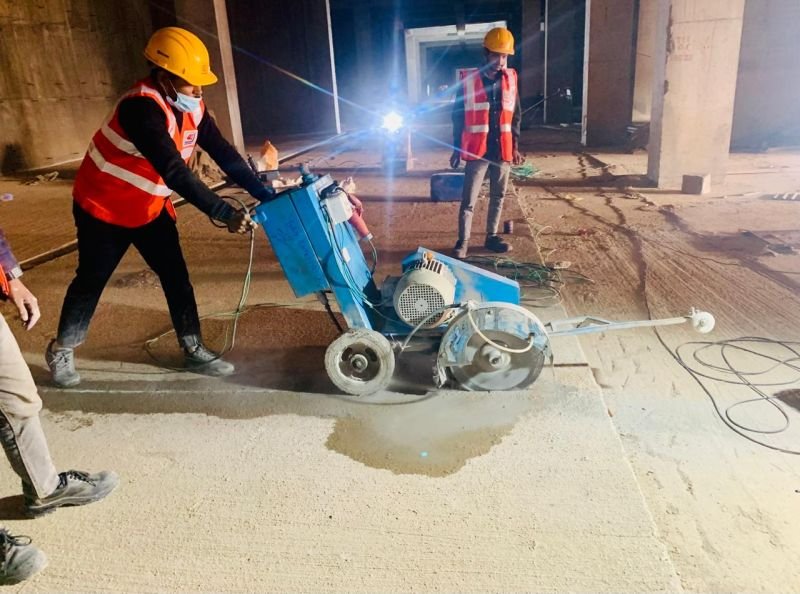
Concrete Floor & Slab Cutting
Diamond saw cutting for control joints, slab openings, trenches and controlled demolition — clean, square cuts without breaking what stays.
Diamond saw cutting lets concrete be cut exactly where it is marked — control joints in a new floor, openings in an existing slab, trenches for services — without the vibration, noise and collateral damage of breaking. We carry out concrete floor cutting and RCC slab cutting on new and occupied sites.
- Best for
- Clean, accurate cuts in floors and slabs without breaking the concrete around them
- Typical sites
- New industrial floors, existing buildings, basements, roads, factory alterations
- Often combined with
- Vacuum Dewatering Flooring, Truss Screed Flooring, Waterproofing Services
What is concrete slab cutting?
Concrete slab cutting uses a diamond-segmented blade mounted on a floor saw to cut through concrete in a straight, controlled line. The blade grinds its way through the concrete — and through the steel reinforcement in RCC slabs — leaving a clean, square edge and sound concrete on either side.
Compared with breaking concrete out with hammers or breakers, sawing sends far less vibration into the rest of the structure, makes much less noise and debris, and leaves an edge that can be built against or finished directly. Water is fed to the blade throughout, cooling it and suppressing dust.
On new floors the most common job is joint cutting: sawing control joints into the slab at planned positions, so that the natural shrinkage of the concrete happens along straight lines rather than as random cracks. On existing buildings, cutting forms openings for stairs, lifts, pits and services, and removes sections for alterations or repairs.
Types of concrete cutting work
Most jobs fall into one of these. The depth that can be cut in one pass depends on the blade and saw, so we confirm what is achievable for your slab during the site visit.
Control joint cutting
Saw cuts in a new floor at planned spacing, timed so the slab cracks along the cut and not at random.
Slab openings
Rectangular openings through floors and RCC slabs for stairs, lifts, ducts and pits.
Trenching
Parallel cuts to open channels for drainage, cables and pipework, with the strip between removed.
Controlled demolition
Cutting a slab into manageable sections so it can be removed without breaking the concrete that stays.
Groove and edge cutting
Grooves for joint sealants, and straight edges around areas that are to be patch-repaired.
Road and yard cutting
Straight cuts in concrete roads, yards and approaches for repairs and service crossings.
Benefits of Slab Cutting
- Accurate, straight cuts The cut follows the marked line, so openings and joints end up exactly where they were planned.
- Low vibration Sawing protects the surrounding structure, finishes and nearby equipment from the shock of breaking.
- Clean edges A square, sound edge can be built against or finished without further trimming.
- Dust kept down Water-fed blades suppress dust at the point of cutting.
- Less noise and debris Much quieter and tidier than breaking — easier to manage in occupied buildings.
- Flexible scheduling Work can be planned at night or during shutdowns to limit disruption.
Where it is used
- Control joints in new industrial floors
- Staircase, lift and duct openings
- Drainage and service trenches
- Factory layout changes and machine foundations
- Basement and parking slabs
- Concrete roads, yards and approaches
Our Slab Cutting process
-
01
Survey and marking
Cut lines are marked, and slab thickness, reinforcement and any embedded services are checked.
-
02
Structural clearance
Openings in structural (RCC) slabs are cut only with the approval of the building's structural engineer, and with temporary propping where they specify it.
-
03
Set-up
Blade, water supply, power and slurry control are arranged, and the work area is barricaded.
-
04
Cutting
Cuts are made along the marked line in passes to the required depth, with water fed to the blade throughout.
-
05
Removal
Cut sections are broken out or lifted and taken away safely.
-
06
Clean-up
Slurry is collected and cleaned up, and edges are checked against the marked line.
Quality and safety considerations
- An opening changes how a structural slab carries load. Openings in RCC slabs must be approved by a structural engineer before cutting — we ask for this, and will tell you when it is needed.
- Reinforcement and embedded pipes or cables are located before any cut is made.
- Wet cutting controls respirable silica dust, and operators wear hearing, eye and respiratory protection.
- Slurry is contained and cleaned so it does not enter drains or stain finished surfaces.
- In new floors, joint cutting is timed to the concrete — too early and the edges ravel, too late and cracks may already have formed.
- Areas below openings are barricaded until cut sections have been safely removed.
Why work with us on this
- Walk-behind diamond floor saws with water-fed blades.
- Work scheduled at night or during shutdowns where production cannot stop.
- Structural approval requested before openings are cut, every time.
From our sites
Frequently asked questions
What is concrete slab cutting?
Concrete slab cutting is the use of a diamond-bladed saw to cut concrete floors and slabs along a marked line. It is used for control joints, openings, trenches and controlled removal of sections, and leaves clean edges without the vibration and damage caused by breaking.
When is concrete cutting required?
Cutting is needed to form control joints in new floors, to make openings for stairs, lifts, ducts and pits, to open trenches for drainage and services, to remove damaged sections for repair, and to alter floors when layouts or machinery change.
Can you cut through an RCC slab?
Yes. Diamond blades cut through concrete and steel reinforcement together. Because cutting an RCC slab changes how it carries load, openings in structural slabs should only be cut with the approval of a structural engineer, who may also specify temporary support.
Is saw cutting better than breaking concrete?
For most work, yes. Sawing gives a clean, accurate edge, keeps vibration away from the rest of the structure, and produces less noise, dust and debris. Breaking may still be used to remove the concrete between saw cuts.
When should joints be cut in a new concrete floor?
As soon as the concrete is hard enough to cut without the edges ravelling — usually within the first day after placing, depending on the mix and the temperature. Cutting too late risks the slab cracking at random before the joints exist.
Vacuum dewatering flooring
How much does concrete cutting cost?
Cutting is generally priced on the length and depth of cut, and depends on slab thickness, reinforcement, access, water and power availability, removal of the cut material, and working hours. We quote after seeing the cut lines on site.
Planning a Slab Cutting project?
Tell us about the site, the finish you need and your programme. We will visit, assess and quote.