
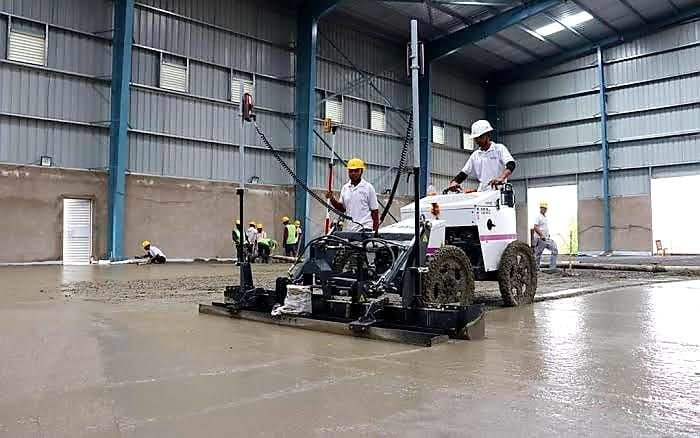
Laser Screed FM2 Flooring
Laser-guided screeding places and levels large floor areas with automatic height control — the usual method for big, flat warehouse floors.
Laser screed FM2 flooring uses a laser-guided screeding machine to place, compact and level concrete across large open areas, adjusting its screed head automatically to a laser reference. It is the usual method for big warehouse and factory floors that need consistent levels, and is the normal way to reach the FM2 free-movement flatness class.
- Best for
- Very large floor areas that need tight, consistent levels
- Typical sites
- Warehouses, logistics parks, factory sheds, large-format retail
- Often combined with
- Vacuum Dewatering Flooring, Jointless Concrete Floors, Concrete Floor Polishing
What is laser screed FM2 flooring?
A laser screed is a self-propelled machine with a long telescopic boom carrying a vibrating screed head. A rotating laser transmitter on site creates a level reference plane; receivers on the screed head read it continuously, and hydraulics raise or lower the head many times a second to keep it on level.
Because the level comes from the laser rather than from side forms, the machine can place wide bays in one operation, reaching across the concrete from outside the pour. Fewer forms are needed, fewer construction joints result, and level is controlled over the whole area instead of only along the form lines.
After screeding, the floor is finished in the normal way — floated and power trowelled, with dry-shake hardener or vacuum dewatering where specified — then joint sawn and cured. The flatness a laser-screeded floor achieves depends on that whole process, not on the machine alone.
How laser screeding keeps a floor level
Four parts of the method do the work. Together they are why laser screeding is chosen for the largest, flattest floors.
Laser reference
A rotating laser sets one level plane for the whole area, so every part of the floor is measured against the same datum.
Automatic head control
Receivers on the screed head read the laser, and hydraulics correct its height continuously as the machine moves.
Wide-bay placing
The telescopic boom reaches into the pour from outside it, placing large areas with fewer forms and fewer joints.
Built-in compaction
A vibrator on the screed head consolidates the concrete as it is struck off, in the same pass.
Benefits of Laser Screed FM2 Flooring
- Consistent levels over large areas Level is controlled from one laser plane across the floor, not from form to form.
- Fewer forms and joints Wide bays mean fewer construction joints — fewer edges to maintain later.
- Faster placing Large volumes can be placed and levelled in a day, shortening the floor programme.
- Even compaction The vibrating head consolidates the concrete uniformly as it screeds.
- Smoother forklift travel Flatter, more consistent floors are easier on trucks, loads and drivers.
- Works with other systems Combines with vacuum dewatering, floor hardeners and steel-fibre concrete.
Where it is used
- Large warehouses and distribution centres
- Logistics and e-commerce fulfilment buildings
- Factory and assembly sheds
- Large-format retail and cash-and-carry stores
- Cold stores
- Hangars and other large open-span buildings
Our Laser Screed FM2 Flooring process
-
01
Planning
Bay sizes, pour sequence, concrete supply rate and laser set-up positions are planned.
-
02
Base preparation
The sub-base is trimmed, compacted and checked for level, and the membrane and reinforcement are placed.
-
03
Laser set-up
The laser transmitter is set to finished floor level and checked against site benchmarks.
-
04
Placing and screeding
Concrete is discharged and the laser screed strikes off and compacts it to level across the bay.
-
05
Finishing
The surface is floated and power trowelled, with hardener or dewatering applied where specified.
-
06
Joints, curing and survey
Joints are sawn, the floor is cured, and flatness is surveyed where the specification requires it.
Quality and safety considerations
- Concrete supply has to keep pace with the machine; interruptions create cold joints and level steps.
- The laser datum is checked against site benchmarks before each pour, because every level on the floor follows it.
- Slump and workability are kept consistent, since variations show up as uneven finishing.
- Finishing is timed to the concrete's set, not the clock — flatness can still be lost at the trowelling stage.
- The machine's working area is controlled, with clear exclusion zones around the boom and moving plant.
Why work with us on this
- Floor design, joint layout and finishing planned together with the screeding.
- Concrete supply and finishing crew sized to the pour, so each bay is completed in one operation.
- Straight advice on whether your floor needs laser screeding, or whether truss screeding will do the job for less.
Watch it on site
Clips from our own projects, in the order the work happens on the floor.
Frequently asked questions
What is laser screed FM2 flooring?
Laser screed FM2 flooring is a concrete floor placed and levelled with a laser-guided screeding machine, finished to the FM2 free-movement flatness class. A laser sets a level reference, and the machine's screed head adjusts to it automatically while vibrating and striking off the concrete, giving consistent levels across large areas.
What does FM2 mean?
FM2 is one of the free-movement flatness classes in TR34, the Concrete Society's guidance on industrial concrete floors. Free movement means forklifts can travel in any direction. It is commonly specified for general warehouse floors; the right class for a floor depends on its equipment and use.
Is laser screed better than truss screed?
Not always — they suit different jobs. Laser screeding covers very large areas quickly with fewer joints and is chosen for big floors with tight flatness requirements. Truss screeding follows side forms and is a practical, lower-cost option for many warehouse and factory floors.
Truss screed flooring
Can laser screeding be used with steel fibre concrete?
Yes. Steel fibre reinforced concrete is commonly placed with laser screeds, and the combination is often used for large floors built with very few joints.
Jointless concrete floors
How much floor area can be laid in a day?
It depends on the concrete supply rate, the placing method, the bay layout, the size of the finishing crew and the weather. Daily output is planned for each project rather than assumed.
How much does laser screed FM2 flooring cost?
It depends on the floor area, slab thickness, concrete grade, reinforcement type, finish, flatness requirement, site access and location. Laser screeding is most economical on large areas. We price after reviewing drawings or visiting the site.
Where we carry out this work
We work across these industrial areas from our base at SIDCUL, Haridwar. Each page covers what this service means for a site there.
- SIDCUL, Haridwar The integrated industrial estate our own yard sits in — auto components, pharma, FMCG and packaging under continuous production.
- Bhagwanpur, Haridwar The Roorkee-side industrial belt in our own district — long-serving sheds alongside new construction.
- Selaqui, Dehradun Pharmaceutical, food and light engineering units on compact plots, where hygiene and finish standards set the floor specification.
- Kashipur, Udham Singh Nagar The Terai industrial belt — agro-processing, paper and chemicals, where humidity governs the programme.
Planning a Laser Screed FM2 project?
Tell us about the site, the finish you need and your programme. We will visit, assess and quote.