
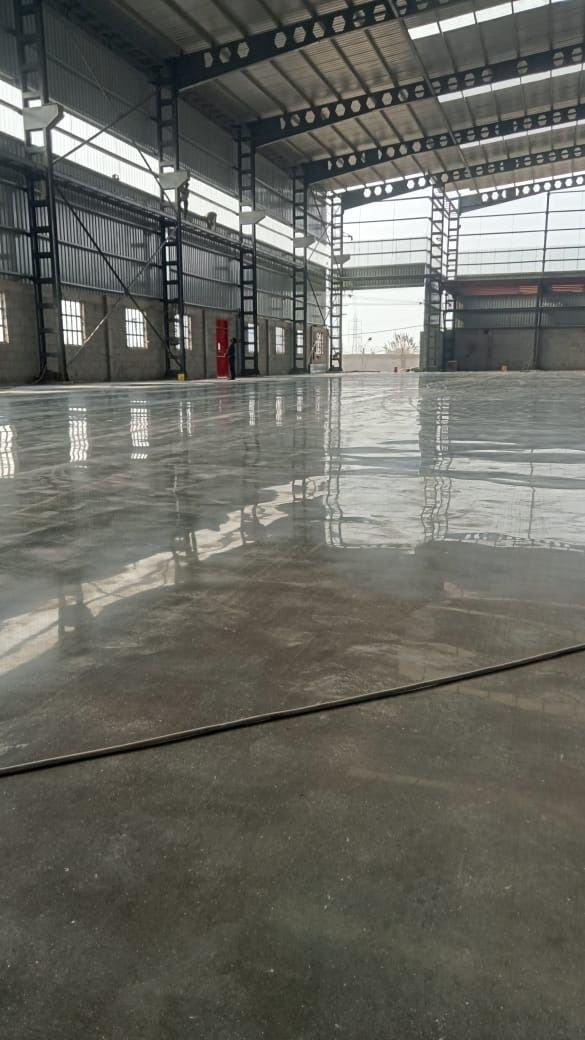
Industrial & Commercial Epoxy Flooring
Seamless resin floors that resist chemicals and abrasion and clean easily — for production, pharmaceutical, food and commercial spaces.
Epoxy flooring bonds a resin system to a prepared concrete slab to create a seamless, hard-wearing surface that resists chemicals and is easy to clean. We prepare and install epoxy floors for factories, warehouses, pharmaceutical and food facilities, and commercial spaces.
- Best for
- Seamless, hygienic, chemical-resistant floors that are easy to keep clean
- Typical sites
- Pharma and food units, production floors, laboratories, warehouses, showrooms
- Often combined with
- Concrete Floor Polishing, Vacuum Dewatering Flooring, Waterproofing Services
What is epoxy flooring?
Epoxy flooring is made by mixing an epoxy resin with a hardener. The two react to form a tough, rigid plastic that bonds strongly to concrete. Laid on a properly prepared slab, it forms a continuous surface with no grout lines or open pores for dirt, liquids or bacteria to collect in.
Epoxy is not one product but a family of systems. A thin roller-applied coating seals and colours a floor for light duty; a self-levelling system gives a smooth, glossy, monolithic surface for production areas; a trowel-applied screed builds thickness for impact and heavy loads. Anti-skid textures and colour-coded walkways can be added to suit the space.
Whether an epoxy floor lasts is decided before the resin is opened. The concrete underneath must be sound, dry enough and mechanically prepared so the resin can bond. Most epoxy failures — peeling, blistering, bubbling — trace back to moisture, contamination or poor slab preparation rather than to the material.
Types of epoxy flooring systems
The right system depends on the traffic, chemicals, hygiene requirements and appearance the floor needs.
| System | What it is | Typically used for |
|---|---|---|
| Epoxy floor coating | Primer plus one or more roller-applied coats — a thin, sealed, coloured surface | Light-traffic stores and workshops; dust-free finish on sound slabs |
| Self-levelling epoxy | Flowable resin spread to a smooth, seamless, glossy finish | Pharma, food and clean production areas; showrooms |
| Epoxy mortar / screed | Resin mixed with graded aggregate and trowelled to a thicker layer | Heavy traffic, impact and point loads; levelling uneven floors |
| Anti-skid epoxy | A coating or self-levelling system with broadcast aggregate for grip | Ramps, wet process areas and walkways |
Benefits of Epoxy Flooring
- Seamless and hygienic No joints or pores for dirt and bacteria to collect in — the reason epoxy is used in pharma and food areas.
- Chemical and oil resistance Resists many oils, fuels, cleaning agents and process chemicals that damage bare concrete.
- Hard-wearing The right system for the load stands up to trolleys, foot traffic and forklifts.
- Easy to clean A smooth, sealed surface can be swept, scrubbed and washed down quickly.
- Colour and marking Colour-coded zones, walkways and safety lines can be built into the floor.
- Dust-free Seals the concrete completely, so the floor itself produces no dust.
Where it is used
- Pharmaceutical manufacturing
- Food and beverage processing
- Manufacturing and assembly lines
- Laboratories and clean areas
- Warehouses and logistics
- Automobile workshops and service centres
- Showrooms and commercial interiors
Our Epoxy Flooring process
-
01
Substrate assessment
Slab strength, cracks, contamination and moisture are checked. New concrete normally needs to cure for around 28 days before resin is applied.
-
02
Mechanical preparation
The surface is diamond ground or shot blasted to remove laitance and old coatings and give the resin a profile to key into.
-
03
Repairs
Cracks, joints and damaged areas are repaired and levelled.
-
04
Priming
A primer penetrates and seals the concrete and forms the bond for the layers above.
-
05
Application
Body coats, the self-levelling layer or the screed are applied to the specified thickness, with texture and colour as required.
-
06
Curing and handover
The floor is protected while it cures, then opened to foot traffic and full use at the times the system requires.
Quality and safety considerations
- Moisture in the slab is the most common cause of blistering and debonding, so it is checked before any resin goes down.
- Temperature and humidity affect how resin cures; application is timed and site conditions managed accordingly.
- Resin and hardener are mixed in exactly the ratio the manufacturer sets — guesswork produces soft or brittle floors.
- Grinding is done with dust extraction, and resins are handled with gloves, eye protection and ventilation as their safety data sheets require.
- Areas stay closed until the floor has cured enough for the traffic it will carry.
- Epoxy is not right everywhere. Floors with rising damp, hot washdowns or cold-room temperatures may need a different resin system, and we will say so.
Why work with us on this
- Preparation is done properly, because that is what decides whether the floor lasts.
- The system is matched to how the floor is used, not one product for every floor.
- Concrete repairs, joint work and resin installation handled by one team.
Frequently asked questions
What is epoxy flooring?
Epoxy flooring is a resin floor made by mixing epoxy resin with a hardener and applying it to prepared concrete. It cures into a hard, seamless surface that resists chemicals and abrasion and is easy to clean, which is why it is widely used in factories, warehouses, pharmaceutical and food facilities.
How long does epoxy flooring last?
It depends on the system and on how the floor is used. A thin coating in a busy area wears sooner than a thick self-levelling or screed system, and floors under heavy forklift traffic wear faster than lightly used ones. Good preparation, the right system for the load and sensible cleaning all extend its life, and worn areas can be re-coated without replacing the whole floor.
Is epoxy flooring suitable for pharma and food industries?
Yes. Seamless epoxy floors are widely used in pharmaceutical and food facilities because they have no joints or pores to harbour dirt and bacteria, and they tolerate regular cleaning. Coved skirting can be formed at wall junctions so floors can be washed down.
Can epoxy be applied over an old concrete floor?
Usually, if the slab is sound. The old surface is ground or shot blasted, contamination is removed, cracks are repaired and moisture is checked. Oil-soaked or badly damaged concrete may need extra work first.
How soon can an epoxy floor be used after installation?
It depends on the system and the temperature. Most floors can take foot traffic within a day or two and heavier traffic a few days later, while full chemical resistance takes longer to develop. We confirm the exact times for the system being used.
What is the difference between epoxy and PU flooring?
Epoxy is harder and more rigid, and is a common choice for production and warehouse floors. Polyurethane (PU) is more flexible and generally copes better with thermal shock and UV. The right answer depends on what the floor actually has to take — tell us the temperatures, the washdown regime and the chemicals involved, and we will say plainly whether an epoxy system suits your area.
How much does epoxy flooring cost?
The cost depends on the system (coating, self-levelling or screed), its thickness, the floor area, the condition of the existing slab and the preparation and repairs it needs, colour and finish, and site conditions. Thin coatings cost less than thick systems. We quote after assessing the floor.
Planning an Epoxy Flooring project?
Tell us about the site, the finish you need and your programme. We will visit, assess and quote.